
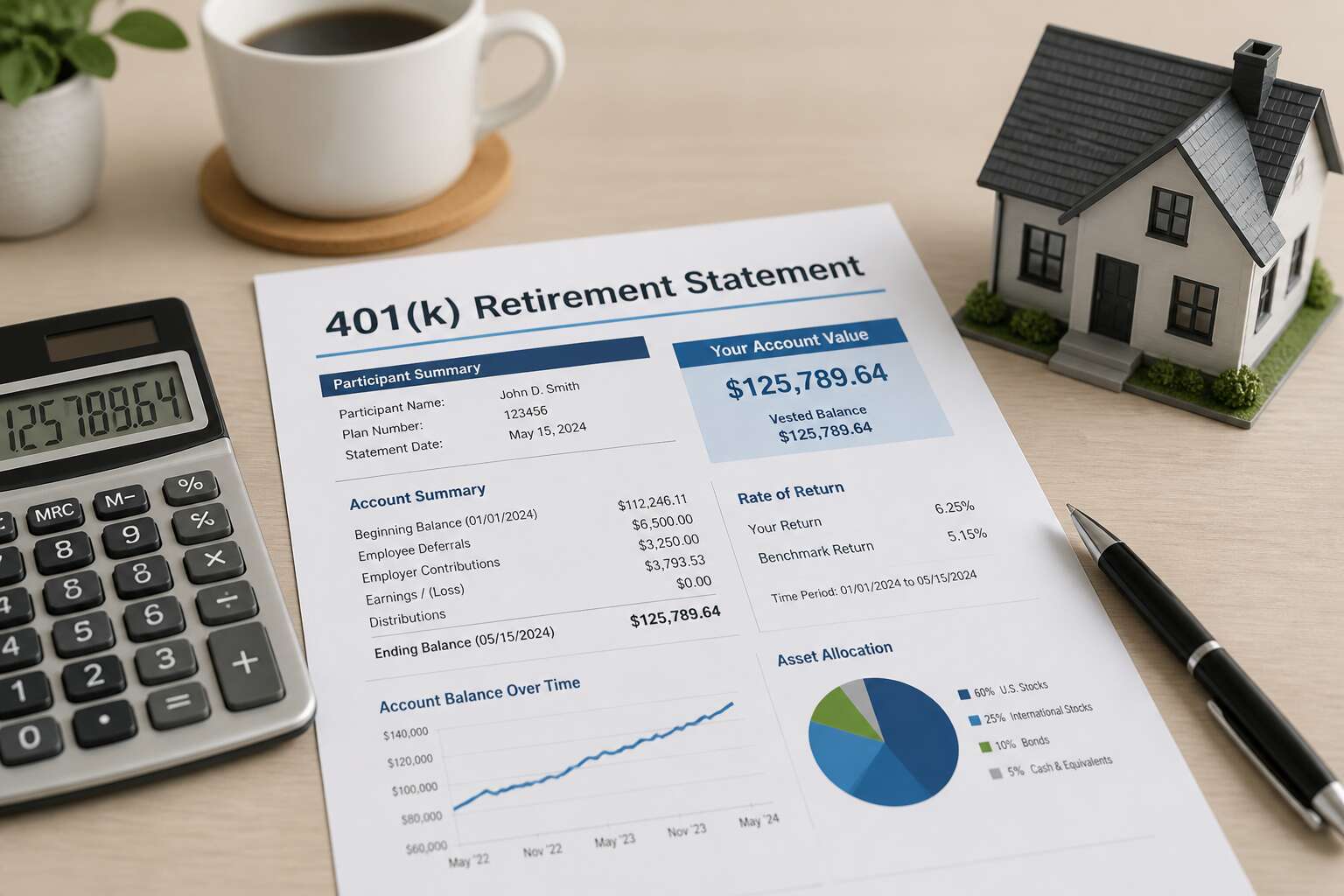
Understanding 401k Borrowing Basics
What Is a 401k Loan and How Does It Work?
Your 401k can serve as a short term loan from 401k, allowing you to borrow from your own retirement savings. The interest you repay goes back into your account, not to a financial institution.
To initiate the process, you submit a request to your plan administrator. The amount you can access depends on your vested balance, and repayment typically occurs through regular payroll deductions over a five year period.
- Maximum loan limits often reach $50,000 or 50% of your vested amount.
- Interest rates usually track the current prime rate plus a small margin.
- If you change employers, the outstanding balance can become due immediately.
That last condition is why a short term loan from 401k needs careful planning. It can solve a temporary cash problem, but it carries real employment risk.
Maximum Loan Limits and Repayment Terms
A startling reality of the American retirement system is that most savers underestimate the ceiling on their own borrowing power. The maximum loan limits often reach $50,000 or 50% of your vested balance, whichever is lower. That figure shapes every decision about using a short term loan from 401k.
Repayment terms rarely stretch beyond five years. Payroll deductions carry the burden automatically, which means your take home pay shrinks quietly each cycle. Some plan administrators offer flexibility. Others do not.
- The borrowed amount cannot exceed the lower of those two thresholds
- Interest rates track the prime rate plus a small margin
- Missed payments trigger specific tax consequences
Understanding these boundaries transforms a short term loan from 401k into a deliberate financial tool rather than a desperate measure.
The True Cost of Borrowing From Your Retirement Account
The money you borrow from your retirement account is never idle. While it sits in your checking account, the market keeps moving without it. A short term loan from 401k means your balance misses every dividend and price swing during the loan period. That opportunity cost compounds quietly, and most borrowers only notice it years later.
Then there is the tax trap. You repay the loan with money already taxed, and you will pay tax again when you withdraw those funds in retirement. The same rand gets taxed twice. That double taxation stings more than most people realise!
- Interest payments go into your own account, but future withdrawals still face income tax
- Defaulting triggers a 10% early withdrawal penalty if you are under 59 and a half
- Your employer may suspend new contributions while the loan is active
That last point hits hardest. Losing the employer match amplifies the real cost of borrowing far beyond the interest rate printed on your loan documents.
Eligibility and Application Requirements
Who Is Eligible to Take a 401k Loan?
Eligibility for a short term loan from 401k hinges on your employment status. You must be an active employee, not a former staff member or independent contractor. I have seen confusion here repeatedly! Each plan has its own rules, so your cousin’s allowance may not apply. You also need a vested balance above the loan amount.
The application runs through your plan administrator, not a bank. Prepare proof of identity, recent payslips, and a signed promissory note. Some administrators also require:
- A completed loan application form with your chosen repayment term.
- Evidence of hardship if you are trying to skip the spousal consent rule.
- Your latest account statement showing the vested amount.
Submitting these does not guarantee approval. The administrator checks for existing loans and judgments. A single mismatch can delay your short term loan from 401k by weeks.
Documents Needed to Start the Borrowing Process
Every application for a short term loan from 401k begins with a quiet audit of your paper trail. The administrator does not know you personally; they know your statements, your payslips, your signatures. One slip, a mismatch between your vested balance and the requested amount, and the process freezes. I have seen people lose momentum over a single outdated utility bill used as proof of address.
To start the borrowing process, you typically need:
- Your latest account statement showing the vested amount.
- Recent payslips or proof of employment.
- A signed promissory note and completed loan form.
- Identification that matches your records exactly.
Hardship evidence and spousal consent waivers appear only when you seek an exception. Submit these without emotion, because the administrator scans for judgments and existing loans first. This borrowing is approved on facts, not intentions.
Steps for Requesting a Loan From Your Plan Administrator
Every request for a short term loan from 401k lands on the same desk: the administrator’s discretion. No two plans process applications identically, and that variance determines your wait. The decision arrives only after they cross-check your requested amount against your vested balance and existing loan portfolio. This is where the process can stall or surge forward depending on your promptness.
The sequence flows predictably:
1. Submit the formal request through the plan’s portal or signed paperwork.
2. The administrator runs a compliance check on your employment status and repayment capacity.
3. Funds land via electronic transfer or cheque, often within five business days.
A joint credit check with your spouse can delay disbursement if your plan requires spousal notification. Ignore the administrator’s requests for clarification at your own peril; each query adds days to your short term loan from 401k approval!
How Long Does Approval Take?
Approval timelines for a short term loan from 401k hinge on paperwork precision and plan-specific rules. Most administrators promise a five to seven business day turnaround, but that clock only starts once your application is complete and error free.
Eligibility requires active employment status and a vested balance that can cover the requested amount. The administrator will check for outstanding loan defaults, which immediately disqualify you until resolved. They also verify that your combined outstanding loans stay within the plan’s percentage cap.
Several factors influence how long approval takes:
– Whether your plan requires spousal consent, which adds a notarization step
– Your response speed to follow up emails or calls for missing information
– The administrator’s internal processing load during peak payroll periods
A clean application with all documents uploaded correctly typically clears in three business days. An incomplete submission resets the cycle entirely, pushing your short term loan from 401k into next week. The eligible borrower who anticipates document requests or spousal signatures beforehand controls their own wait time.
What Happens if Your Employer Changes Plan Providers
A plan provider change is a quiet disruption. Your outstanding debt transfers, yet your borrowing history often doesn’t carry over automatically. The new administrator may treat you as a fresh applicant, which means your short term loan from 401k eligibility gets reviewed again from scratch.
Your employment status and vested balance remain the core checks. But the new provider might impose different limits, lower caps, or added documentation. Spousal consent requirements can change too, depending on the plan’s new service agreement.
So track these items during any provider transition:
- Your plan’s new loan policy summary
- Confirmation that existing loan payments are correctly transferred
- Updated contact details for the administrator’s loan desk
You can still apply for a short term loan from 401k in the middle of a provider switch, but expect extra verification. Wait until the transition settles if your plan’s rules are unclear.
Pros and Cons of Borrowing From Your 401k
Advantages of Borrowing From Yourself
Borrowing from your retirement fund creates an uneasy arrangement with your future self. The immediate benefit is undeniable. You bypass credit checks, avoid high-interest lenders, and the interest you pay flows back into your own account. For a short term loan from 401k, the turnaround time is intoxicating.
Yet the hidden costs persist. If you resign, the outstanding balance may convert to an early distribution with penalties. More quietly, withdrawals reduce your portfolio’s compounding growth. That lost growth often outweighs the convenience.
Consider the trade-offs:
- Interest paid to yourself still reduces your available cash
- Repayment with after-tax money creates a potential double tax on later withdrawals
I have watched colleagues treat this option as a simple advance. It is more complex. A short term loan from 401k remains a calculated move, not an emotional reaction.
Interest Rates and Fees to Watch For
There is a persistent myth that borrowing from your future pension is a zero cost transaction. Nothing could be further from the truth, especially when you inspect the interest rate and fee structure. The plan sets a fixed rate, usually based on the prime rate plus a margin. This rate is not a penalty, but it is also not a bargain. You are paying yourself back, sure, but you are doing so with money that could have been invested elsewhere.
The administrative fees are often the sneaky culprit. While the interest is paid into your own account, the setup fee is pure profit for the plan administrator. These costs, which can be a flat amount or a percentage of the loan, are deducted from your balance before you see a cent. For a short term loan from 401k, this front loaded cost can make the effective annual rate much higher than the advertised number.
– The origination fee is non refundable.
– There is often an annual maintenance fee for the duration of the loan.
– A per transaction fee might apply if you miss a payment and need to reschedule.
The concept of double taxation is a bitter pill. You repay the loan using after tax dollars, and when you eventually withdraw that money in retirement, you pay income tax on it again. The interest you pay yourself is taxed twice. The convenience of a short term loan from 401k is a well marketed temptation, but the fiscal reality is that you are paying a premium to borrow your own cash. It is a liquidity solution, but it is not a free one. The loss of compounding on the borrowed amount is often the heaviest toll, a silent partner in this transaction that demands a hefty cut of your future growth.
How a Loan Can Jeopardize Your Retirement Growth
Borrowing from your future self feels like a victory. The money is already yours, approval takes days, and repayments slip from your paycheck unnoticed. For South Africans, a short term loan from 401k offers a solution during retrenchment or medical emergencies. Yet this ease hides a danger.
The pros are tangible: no credit check, no bank, and interest that returns to your own account. The cons are less visible. Every rand borrowed stops growing. The market may rally while your money sits idle, and full recovery takes years. Trust me, that gap is hard to close!
The sharper truth:
- Your employer can demand full repayment if you leave for a better job.
- Missed payments count as distributions, triggering tax and penalties.
- New contributions may be paused while you repay, delaying your entire savings plan.
A short term loan from 401k can preserve your present, but it may shrink your retirement.
The Serious Consequences of Defaulting
The seduction of a quick cash injection is powerful. A short term loan from 401k feels like an emergency exit, a way to bridge the gap between today’s crisis and tomorrow’s pay check. You borrow from yourself, and the interest goes back to your own account. It is a neat system on paper. The reality is far more insidious, and the fine print holds a clause that could unravel your financial future.
The pros of borrowing are straightforward. You bypass the credit bureaus and the invasive scrutiny of a bank manager. For South Africans facing retrenchment, this speed is a lifeline. The interest rate is often lower than a personal loan, and since the interest returns to you, it feels like you are paying yourself a premium. Yet, this comfort zone is exactly where the risk festers. When you sign for a short term loan from 401k, you are signing a contract with your future discipline.
The consequences of defaulting, however, are where the story turns dark. The moment you miss a payment, the IRS, and by extension the South African tax authorities, view your behavior through a punitive lens. That loan transforms from a debt to a premature distribution. This is not a polite warning; it is a financial seizure.
The specific penalties are brutal and layered:
1. The outstanding balance is added to your gross income for the year.
2. You face an additional 10% early withdrawal penalty if you are under the age of 59 and a half.
3. The double taxation of the interest occurs because you pay it back with after-tax dollars.
The Tax Man does not care that the money was for a medical emergency. He sees a withdrawal, and he wants his share immediately. If you lose your job and cannot settle the debt within the 60 day grace period, the entire load becomes payable. There is no negotiation. This is the sharp edge of the blade, and it cuts deeper than the relief of the initial loan.
A default also freezes your financial progress. The loan you could not repay reduces your retirement balance permanently. The market gains you missed are gone, and the taxes cripple your monthly budget. The illusion of borrowing from yourself dissolves when the government steps in. You are left with a depleted fund and a tax bill that lingers for years. Is the temporary relief of a short term loan from 401k worth that haunting shadow?
Repayment Strategies and Pitfalls
Standard Repayment Schedules Explained
The standard repayment schedule for a short term loan from 401k is rarely negotiable. Your plan administrator fixes a payment amount, deducted from each paycheck, designed to clear the debt within the maximum term. Level payments remain constant, which provides predictability but also means you carry the full interest burden until the final instalment.
Pitfalls hide in the details. Miss a payment and the plan records it immediately, often triggering a penalty or accelerating the remaining balance. If you resign or are retrenched, the schedule collapses entirely and the full amount can become due within 60 to 90 days.
For anyone carrying a short term loan from 401k, repayment strategies worth weighing include:
– Setting automatic deductions aligned to your pay cycle
– Making occasional lump sum payments when the plan permits
– Revisiting the budget after any salary adjustment
Each of these requires planning. The schedule itself is fixed, so your own discipline determines whether you finish the term intact.
How Payroll Deductions Facilitate Repayment
Many borrowers overlook how a payroll deduction remaps their monthly cash flow. The mechanism works without effort. Each pay cycle, the plan administrator extracts the scheduled amount before you see your salary. This is the strongest feature of a short term loan from 401k, because it removes the temptation to spend elsewhere. The deduction is unyielding. You cannot skip it accidentally, and you cannot forget it.
Pitfalls still surface, and they usually stem from changes in your income. A salary cut makes the fixed deduction heavier. A second job loss makes it impossible. What the deduction does:
– Forces you to adapt to a smaller take home pay immediately
– Exposes your spending discipline, because the margin for error becomes thin
– Removes any grace period, since payment is instant and automatic
The deduction also creates a false sense of security. Just because the payment is automatic does not mean the cost is neutral. Every rand withdrawn from your paycheck is a rand that cannot cover rent, groceries, or transport. For a short term loan from 401k, this is the real trade off. The convenience of automation is real, but it does not reduce the interest or the risk. If you resign, the deduction stops entirely, and the balance accelerates. That is the moment the strategy unravels.
What Happens to Your Loan if You Leave Your Job
Most retirement plan documents contain an acceleration clause, a term I rarely see borrowers read until they resign. The clause transforms a short term loan from 401k into a full balance due within 60 to 90 days. Your employer’s HR department will issue a final notice, and the plan administrator will calculate your outstanding principal plus accrued interest.
The options are stark:
- Repay the total balance before the deadline
- Allow the loan to default, converting it into a taxable distribution
- Roll the balance into another qualified plan if your new employer permits
A defaulted short term loan from 401k carries more than a tax bill. The IRS treats the outstanding amount as an early withdrawal, adding a 10% penalty. Borrowers who land new jobs quickly assume they can simply continue their old payment schedule. They cannot. The payroll deduction stops with your employment, and the repayment discipline you relied on disappears.
Options for Paying Off Your 401k Loan Early
Paying off a short term loan from 401k early has one major snag: your plan’s prepayment rules. Some plans accept extra payments at any time, while others lock you into the payroll deduction schedule. You might write a lump sum cheque with great pride, only to find the plan applied it to future payments instead of the principal.
Another trap appears in your tax withholding. If you boost your retirement contributions after repaying, your take home pay drops. That looks like a reward, but it reduces the cash flow you need elsewhere. The strategy that works is less glamorous:
- Read the prepayment clause before sending any money
- Instruct the administrator to apply extra amounts to principal
- Leave your emergency fund untouched
The most reliable approach treats repayment like a fixed monthly cost. Every short term loan from 401k should be retired with planning, not impulse.
Can You Refinance or Renegotiate a 401k Loan?
Can you refinance a short term loan from 401k? The honest answer is a resounding no. You are borrowing from your own future self, so there is no bank to haggle with and no competing interest rates to wave around. Your plan administrator sets the terms, and they rarely budge on the schedule.
Some people wonder if they can quietly negotiate a lower interest rate on a short term loan from 401k by threatening to take their business elsewhere. That approach fails because you are the only customer. The plan is a legal structure, not a lending manager with bonus incentives.
What you can do is explore alternative plan features. The rules might allow:
– A paycheck recalculation for a shorter remaining term.
– A lump sum repayment to clear the principal.
– A suspension of new contributions to ease cash flow.
None of these are renegotiations. They are administrative options that still follow the original contract. If repayment feels suffocating, remember that the fix is personal discipline, not a friendly phone call to adjust your own debt.
Dealing With Missed Payments and Financial Hardship
Missed payments on a short term loan from 401k trigger a quiet clock. The IRS allows a cure period, often until the end of the calendar quarter following the missed payment. If you fail, the remaining balance becomes a distribution. That means income tax plus a ten percent early withdrawal penalty. The obligation does not vanish. It morphs into a heavier burden.
Repayment strategy during hardship requires honesty about your cash flow. Prioritise the loan over discretionary spending. If you cannot, consider reducing contributions temporarily. Many plans allow loan suspension under hardship rules, but this varies.
- rolling the debt onto credit cards
- ignoring plan notices
- assuming default forgives the amount
Each misstep raises the cost. A short term loan from 401k remains your responsibility until the plan administrator closes the account.
Alternatives Worth Considering Before You Borrow
Personal Loans vs. 401k Loans
Borrowing against your retirement carries consequence, but a short term loan from 401k is not your only option. Personal loans from a bank or credit union often carry higher interest, yet they leave your retirement principal fully intact. That distinction matters when you consider decades of compound growth. Before you take a short term loan from 401k, consider the alternatives carefully.
A separate path involves negotiating a payment plan directly with creditors or using a credit card with a zero percent introductory rate. These alternatives come with their own risks, so compare the total interest cost before deciding.
- List the full repayment amount for each option.
- Review the default consequences for both loans.
- Determine how each affects your monthly cash flow.
A personal loan may solve the immediate moment without disturbing the long-term growth of your retirement savings. The right choice depends on your timeline, your discipline, and the true price of each rand borrowed.
Home Equity Lines of Credit as a Substitute
Home equity lines of credit present a compelling alternative to a short term loan from 401k. You borrow against your property’s value, keeping your retirement funds untouched. Interest rates often beat unsecured loans, yet the variable nature can complicate budgeting!
Weigh these points carefully:
- Your home becomes collateral, meaning default risks foreclosure.
- Closing costs and annual fees reduce the apparent savings.
- Repayment periods extend beyond a typical retirement loan term.
Borrowing from your retirement avoids property risk, but it demands disciplined repayment. South African homeowners must decide which asset deserves protection. The answer hinges on your repayment certainty and long term financial goals.
When a Hardship Withdrawal Might Be a Better Option
One in three South Africans accesses retirement savings prematurely. That statistic should give any borrower pause. A short term loan from 401k seems convenient, yet it creates a payroll deduction and potential default risk. Before committing, consider simpler routes. An emergency fund, even a modest one, covers small gaps. A personal credit check might reveal cheaper options. Sometimes you can negotiate a payment extension with your provider.
If your hardship is genuine, a withdrawal might beat a loan. Hardship withdrawals avoid repayment pressure, but they trigger income tax and early withdrawal penalties. Compare that to a loan where missed payments reduce your retirement balance.
Consider these alternatives:
- Stokvel or community savings group
- Bank overdraft facility
- Debt counsellor intervention
A hardship withdrawal works when you have no capacity to repay. Choose only after full assessment.



0 Comments