
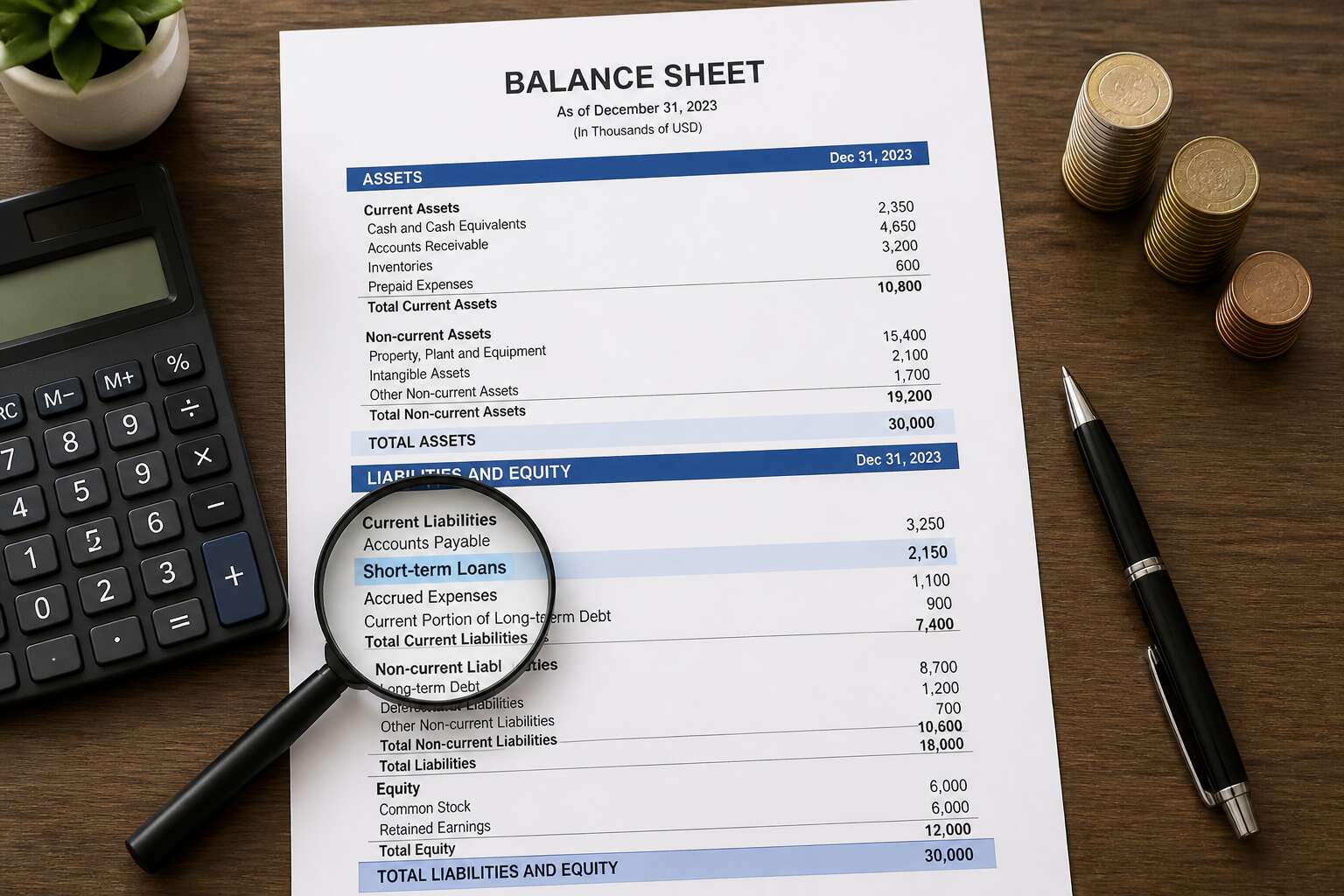
Understanding Short-Term Loans and Their Role in Financial Statements
Defining Short-Term Debt and Its Key Characteristics
In South Africa, the average small business carries roughly 40% of its total debt in obligations due within twelve months. Those obligations, recorded as current liabilities, include the short term loans in balance sheet entries that financial analysts scrutinise first.
Short term debt is any borrowing with a maturity under one year. It appears under current liabilities, alongside trade payables and accrued expenses. I have found these traits consistently define it:
- Repayment within twelve months, typically funded by operational cash flow
- Interest rates that feed directly into the income statement
- Meaningful effects on the current ratio and other liquidity metrics
These characteristics clarify how a company finances its daily operations and whether it relies on external credit to cover cash shortfalls.
Common Sources of Short-Term Loans: Bank Lines, Commercial Paper, and Revolving Credit
Few instruments cause as much hand-wringing as the revolving credit facility. When drawn, it appears among the short term loans in balance sheet figures; when untouched, it remains a footnote. This ambiguity makes it the favourite topic of cautious treasurers and nosy auditors alike.
Bank lines and commercial paper operate with comparable elegance, though their manners differ. A bank line offers flexibility, while commercial paper demands punctuality. Both cover the gap between paying suppliers and collecting from customers. In South Africa, where cash flow is temperamental, these instruments carry most of the daily financing burden. Their place in the short term loans in balance sheet category dictates how analysts read liquidity.
The common sources each carry their own etiquette:
- Bank lines, negotiated with a single institution, offer room to manoeuvre
- Commercial paper, unsecured and issued to investors, demands impeccable credit
- Revolving credit, drawn and repaid as needed, suits unpredictable cash flows
Each source leaves a distinct fingerprint on the financial statements.
Key Differences Between Short-Term and Long-Term Liabilities
Every financial statement tells a story of timing. Short term loans in balance sheet entries reveal obligations due within twelve months, while long term liabilities stretch beyond that horizon. This distinction shapes every liquidity ratio and covenant test.
- Short term liabilities are settled within one operating cycle
- Long term liabilities extend past that cycle
- Interest rates and collateral terms often differ
I have watched analysts examine the short term loans in balance sheet figures with urgency. Long term debt allows for patience; short term debt demands payment. The former is a commitment, the latter a reckoning. Both matter, but only one tests your survival each quarter. What a difference a year makes!
Classification and Measurement of Short-Term Loans on the Balance Sheet
Current vs. Non-Current Classification Criteria Under IFRS and US GAAP
Classification of a short term loan feels obvious, but the balance sheet asks for nuance. I find that under IFRS and US GAAP, the current versus non-current test relies on settlement timing. A liability is current if due within twelve months, though a longer operating cycle can shift that boundary.
Measurement follows amortised cost using the effective interest method. Some firms choose fair value, yet that is uncommon for short maturities. Short term loans in balance sheet presentation affects liquidity ratios directly.
Remember these criteria!
1. A refinancing agreement signed before the reporting date can retain non-current status.
2. A covenant breach forces the loan into current liabilities.
3. A revolving facility with a demand feature always lands current.
Short term loans in balance sheet classification requires judgment, especially when rollover intentions conflict with legal maturity. One missed detail warps working capital analysis.
Initial Recognition and Measurement Principles for Borrowings
Most finance teams underestimate how origination fees distort the initial carrying amount of a borrowing. For short term loans in balance sheet presentation, start with fair value less directly attributable transaction costs. A R100,000 loan with R2,000 in fees records at R98,000. The difference flows into interest expense.
After initial recognition, measurement follows amortised cost using the effective interest method. This allocates fees and any discount or premium across the period. For short term loans in balance sheet terms, the effective rate often differs from the nominal rate. Here is what to capture:
- Origination fees paid to the lender
- Third-party legal and valuation fees
- Commitment or facility fees
Each item affects the effective yield. A revolving credit line complicates things because undrawn amounts may still carry fees. The balance sheet shows only drawn amounts as a liability, yet the effective rate must absorb all costs. That nuance changes liquidity ratios.
Subsequent Measurement and Accrual of Interest Payable
Interest payable rarely gets the attention it deserves. A loan drawn on the 28th accrues interest for the final two days, yet many teams only book the payment when it hits the bank account. For short term loans in balance sheet presentation, that missed accrual overstates profit and understates liabilities.
Subsequent measurement under amortised cost still applies, but the accrual is the operational layer. You track the interest earned by the lender but not yet paid. This sits separate from the principal.
Here is what to verify each month end:
- Interest accrued from the last payment date to the reporting date
- Amortisation of the original transaction fees for the same period
- Fees on undrawn commitment amounts
For short term loans in balance sheet terms, the accrued interest line affects the current ratio and the quick ratio. Miss it and your working capital position looks healthier than it is.
Foreign Currency Revaluation of Short-Term Debt
Classification of short term loans in balance sheet depends on maturity and currency denomination. A facility repayable within twelve months belongs under current liabilities, yet the measurement becomes more complex when the loan is not in rand.
Foreign currency revaluation of short term debt is mandatory at each reporting date under IFRS. You translate the principal at the closing spot rate and recognise the exchange difference in profit or loss. A depreciating rand inflates the rand value of a USD loan, which directly reduces equity and distorts gearing ratios.
Common exposures in South African balance sheets:
- USD trade finance facilities
- EUR import funding lines
- GBP commercial paper
Each one requires a consistent revaluation process, otherwise the reported liability understates the true settlement amount.
Impact of Debt Modifications, Renewals, and Extinguishment
A revised repayment schedule can do more than ease cash flow; it changes how short term loans in balance sheet are measured. When a lender agrees to modified terms, compare the present value of old and new cash flows. A substantial difference, commonly a shift of ten percent or more, means the original debt is extinguished and a fresh liability takes its place. A minor tweak simply adjusts the effective interest rate.
Renewals follow their own logic. A facility maturing in March but rolled over in December keeps its current classification because the lender cannot demand repayment within twelve months. Delay the renewal until after year end and the full amount may need reclassification as long term.
Extinguishment is the moment of truth. You remove the carrying amount, recognise any difference in profit or loss, and watch gearing ratios shift. The treatment of short term loans in balance sheet becomes a matter of timing, not preference.
Presentation and Disclosure Requirements for Short-Term Borrowings
Balance Sheet Line Items and Net Debt Presentation
Investors rarely see a single, definitive net debt figure in audited financial statements. The placement of short term loans in balance sheet schedules tells a story of liquidity and refinancing risk, but that story depends heavily on presentation choices.
Under IAS 1, current financial liabilities require separate presentation, yet aggregation levels remain a matter of professional judgement. Most South African companies show short-term borrowings as a distinct line within current liabilities. The notes then carry the effective interest rate, carrying amount, and any assets pledged as collateral. Net debt presentation, by contrast, is entirely voluntary!
- Opening to closing reconciliation of gross debt
- Cash and cash equivalents applied against borrowings
- Undrawn committed facilities that signal liquidity headroom
These reconciliations give investors a transparent window into refinancing risk. But any offsetting of cash against debt must follow IAS 32 criteria, or the short term loans in balance sheet presentation loses its credibility.
Required Footnotes, Maturity Tables, and Credit Risk Disclosures
The notes to the financial statements are where the real story of short term loans in balance sheet presentation unfolds. IAS 1 demands specific disclosures, but the detail lives in the footnotes. Interest rates, collateral arrangements, and repayment terms must all surface there. South African companies typically present a maturity table showing when obligations fall due.
Credit risk disclosures add another layer. They reveal how lending facilities are structured and whether covenants remain intact. I always scan these first because they expose refinancing risk that short term loans in balance sheet footnotes can obscure.
- Effective interest rates for each borrowing class
- Carrying amounts reconciled to fair value where applicable
- Assets pledged as security
- Undrawn facility amounts and their expiry dates
Each requirement serves a purpose. The maturity table signals liquidity pressure points. The credit risk section flags covenant breaches. Together, they turn a static line item into a forward looking risk profile.
Off-Balance Sheet Arrangements, Guarantees, and Unused Credit Lines
Off balance sheet arrangements create tension. A guarantee extends your company’s risk beyond the liabilities shown on the statement of financial position. An unused credit line offers liquidity that never appears as a debt. Yet both demand disclosure.
In South Africa, the practice follows IAS 24 for related party guarantees and IAS 37 for contingent liabilities. The key distinction rests on probability. A guarantee that is likely to be called becomes a provision. One that merely hovers as a possibility stays in the notes.
For unused credit lines, the undrawn amount appears in the commitments section of the annual financial statements. This tells readers exactly how much headroom exists. Short term loans in balance sheet presentation often miss this nuance, because the drawn portion sits as a liability while the undrawn portion lives entirely in the narrative.
Analyzing Short-Term Loans Through Financial Ratios and Metrics
Current Ratio and Working Capital Implications
The current ratio offers the first glimpse into whether a company can meet its obligations. Analysts divide current assets by current liabilities, and the resulting figure reveals liquidity pressure. Short term loans in balance sheet positions often distort this metric, especially when revolving credit sits fully drawn.
Working capital tells a deeper story. Subtract current liabilities from current assets, and you see the buffer between survival and distress. A positive figure suggests room to operate. A negative one signals dependency on lenders.
- The composition of current assets
- Whether inventory is liquid or slow moving
- The ratio compared against industry peers
When short term loans in balance sheet entries grow faster than operating cash flow, the ratio deteriorates. South African businesses face this tension daily, particularly where seasonal demand forces heavy borrowing.
Quick Ratio and Stress-Testing Liquidity Positions
The quick ratio strips away inventory to expose a harsher liquidity truth. You divide cash, marketable securities, and receivables by current liabilities, and the result reveals what remains when stock cannot be sold quickly. South African retailers and manufacturers often watch this number plummet during seasonal troughs, when stockpiles peak and payment cycles stretch.
Stress testing liquidity positions means running scenarios that force discomfort. What happens if debtors settle 30 days late? What if a committed credit line shrinks overnight? Each simulation shows how long operations can continue without fresh funding.
- Assess borrowing capacity against current asset values
- Test interest cover under repricing shocks
- Review covenants that could trigger early repayment
When short term loans in balance sheet entries grow faster than cash conversion cycles, the quick ratio becomes the first warning signal. Discipline here prevents a liquidity crisis from turning into a solvency event.
Debt-to-Equity Ratio with a Focus on the Short-Term Portion
Most investors read the debt-to-equity ratio as a single number, but I always split out the short-term component first. When short term loans in balance sheet entries pile up under current liabilities, the ratio takes on a different meaning. A Johannesburg manufacturer with R50 million in equity and R30 million in short-term borrowings shows a 0.6 ratio, yet that figure hides the repayment pressure!
Separating the short-term portion from long-term debt transforms the metric. Analysts should evaluate:
- The share of short-term debt within total liabilities
- The repayment schedule across the next 12 months
- The operating cash flow available to settle those obligations
Each element reveals whether the leverage is manageable or merely deferred. South African lenders view a rising ratio driven by short term loans in balance sheet items as a warning, especially when long-term debt stays flat.
Interest Coverage and Cash Flow Adequacy for Servicing Debt
When a loan matures in eleven months, interest coverage matters more than the repayment schedule alone. Short term loans in balance sheet entries under current liabilities demand a closer look at operating profit against interest expense. A ratio near 1.5 leaves little room for error, especially with rand volatility affecting input costs.
Cash flow adequacy is the quieter metric. Free cash flow after working capital changes shows what actually funds debt servicing. Analysts compare that figure to total short-term obligations due within the year:
- Interest coverage below 2.0 signals strain
- Negative free cash flow cancels headline earnings
- Working capital swings delay repayment capacity
Short term loans in balance sheet items become far less opaque when tested against these figures. The income statement and cash flow statement clarify what the balance sheet merely suggests.
Turnover Metrics: Short-Term Loans vs. Operating Trade Liabilities
The distinction between short term loans in balance sheet entries and operating trade liabilities emerges through turnover metrics. I find that trade creditors turn with the operating cycle, their rhythm tied to inventory moving and invoices settling. Short-term loans follow a different cadence, one governed by contractual maturities rather than commercial flow.
Days payable outstanding for operating liabilities might stretch to 60 or 90 days in South Africa’s current climate. Short-term borrowings, however, rarely offer such elasticity. Creditors extend grace through negotiation; lenders demand adherence to covenants. That contrast deserves attention!
A few questions sharpen the analysis:
– Is the company using loan proceeds to fund assets that turn faster than the loan term?
– Are trade payables stretching while short term loans in balance sheet positions remain static?
– Does the operating cycle accelerate beyond the maturity ladder?
The mismatch between these cycles often reveals distress before the income statement does.
Covenant Compliance and Refinancing Risk Assessment
A covenant breach rarely announces itself with a bang. Often it slips through a ratio that weakened a quarter earlier.
When I analyze short term loans in balance sheet positions, I look beyond the common liquidity ratios to the headroom available under each covenant. The metrics that matter are those measuring the distance to default, such as fixed charge coverage and leverage ratios. In South Africa’s rate environment, that headroom can shrink quickly. Monitoring requires a disciplined checklist:
- Debt service coverage ratio
- Minimum liquidity buffer thresholds
- Maximum debt to EBITDA ceilings
Refinancing risk assessment demands a maturity ladder, not merely a total figure. I track each drawdown’s rollover date against the operating cash flow forecast. A lender’s willingness to renew depends on the same metrics that a credit committee reviews. When short term loans in balance sheet entries accumulate without matching asset turnovers, the refinancing conversation changes tone. The borrower must present a credible cash generation plan, not merely an asset register.
Effects of Short-Term Loans on Other Financial Statements and Decision-Making
Income Statement Impact: Interest Expense, Original Issue Discount, and Amortization
The balance sheet displays the principal, yet the income statement bears the true cost of short term loans in balance sheet. Interest expense is the direct cost, but the original issue discount (OID) is the hidden one. When lenders issue a loan at a discount, you must amortize that discount over the loan’s lifespan, inflating the periodic interest charge beyond the actual cash outflow. The cash flow statement shows the physical payment, while the income statement reports the accrued figure; the gap can mislead.
Here is the sequence of recognition that I often walk clients through:
- Interest expense on the nominal amount.
- Amortization of the OID to interest expense.
- Commitment fees, treated as finance costs over time.
This divergence also impacts retained earnings and, by extension, the statement of changes in equity. For South African firms, this distinction matters because your financial statements must adhere to IFRS, and the Tax Court has specific rules for deductibility. Treating short term loans in balance sheet as a simple liability misses this nuance. A manager who watches both figures can set pricing margins with accuracy.
Cash Flow Statement Classification of Borrowing Proceeds and Repayments
The cash flow statement rarely matches the balance sheet’s calm arithmetic. Borrowing proceeds appear as financing inflows, while repayments exit as financing outflows. For short term loans in balance sheet, this creates a trap. When a company draws and repays a facility within the same period, the gross figures can hide the true net position. Managers who chase operating cash flow targets may overlook these distortions.
South African lenders under IFRS face a classification choice under IAS 7 for interest paid. The decision to treat it as operating or financing affects reported performance.
When reviewing this relationship, I ask clients to verify:
– The net movement in short term loans in balance sheet equals proceeds minus repayments.
– Non-cash transfers, such as refinancing between facilities, are excluded from the cash flow statement.
– Foreign currency revaluation does not mask the underlying cash flows.
These checks keep the decision-making process honest.
Implications for the Statement of Changes in Equity and Retained Earnings
The effect of short term loans in balance sheet extends beyond the liability section. Each interest payment reduces profit after tax, and that reduction flows directly into retained earnings in the statement of changes in equity. Under IAS 21, foreign currency borrowings may be revalued through other comprehensive income, creating a translation reserve. This reserve can obscure true profitability.
For directors, the implications are practical:
- Interest expense lowers distributable retained earnings.
- Refinancing pressure discourages generous dividend declarations.
- Currency losses on foreign debt may accumulate in equity without touching the income statement.
When a company holds significant short term loans in balance sheet, the equity statement becomes a map of these pressures. I find that investors read retained earnings movements as signals of management confidence, sometimes more carefully than the income statement itself.
Strategic Considerations for Financial Managers, Lenders, and Investors
When a finance manager sees short term loans in balance sheet, the immediate decision-making burden centers on liquidity timing. Interest paid lands in operating cash flow, which distorts the underlying performance number. Lenders must compare the repayment schedule against actual receivables, beyond the static liability figure.
Investors read refinancing aggression from the statement of cash flows. Repeated borrowing proceeds signal a dependency that net profit alone cannot reveal. This dynamic changes how shareholders assess management’s risk appetite!
- Match maturities to the cash conversion cycle.
- Stress-test liquidity beyond the quick ratio.
- Evaluate interest rate sensitivity on the income statement.
This holistic view of short term loans in balance sheet clarifies the strategic posture for all parties involved.



0 Comments